Enter your email to receive alerts for this author.
Sign in or create an account to better manage your email preferences.
Are you sure you want to unsubscribe from email alerts for Nadira Goffe?
As is fitting for a story about a man lost at sea for years, Christopher Nolan’s blockbuster adaptation of the classic Greek epic the Odyssey was destined to make waves. The Odyssey premieres this week, but even before it hits screens nationwide, the film—something of an epic itself, given its nearly three-hour runtime—has already broken the record for the highest IMAX ticket presales of all time. Simultaneously, a more sinister wave has threatened to capsize discussion of the movie, going back to when a casting announcement reignited—what else—the ever-simmering culture wars.
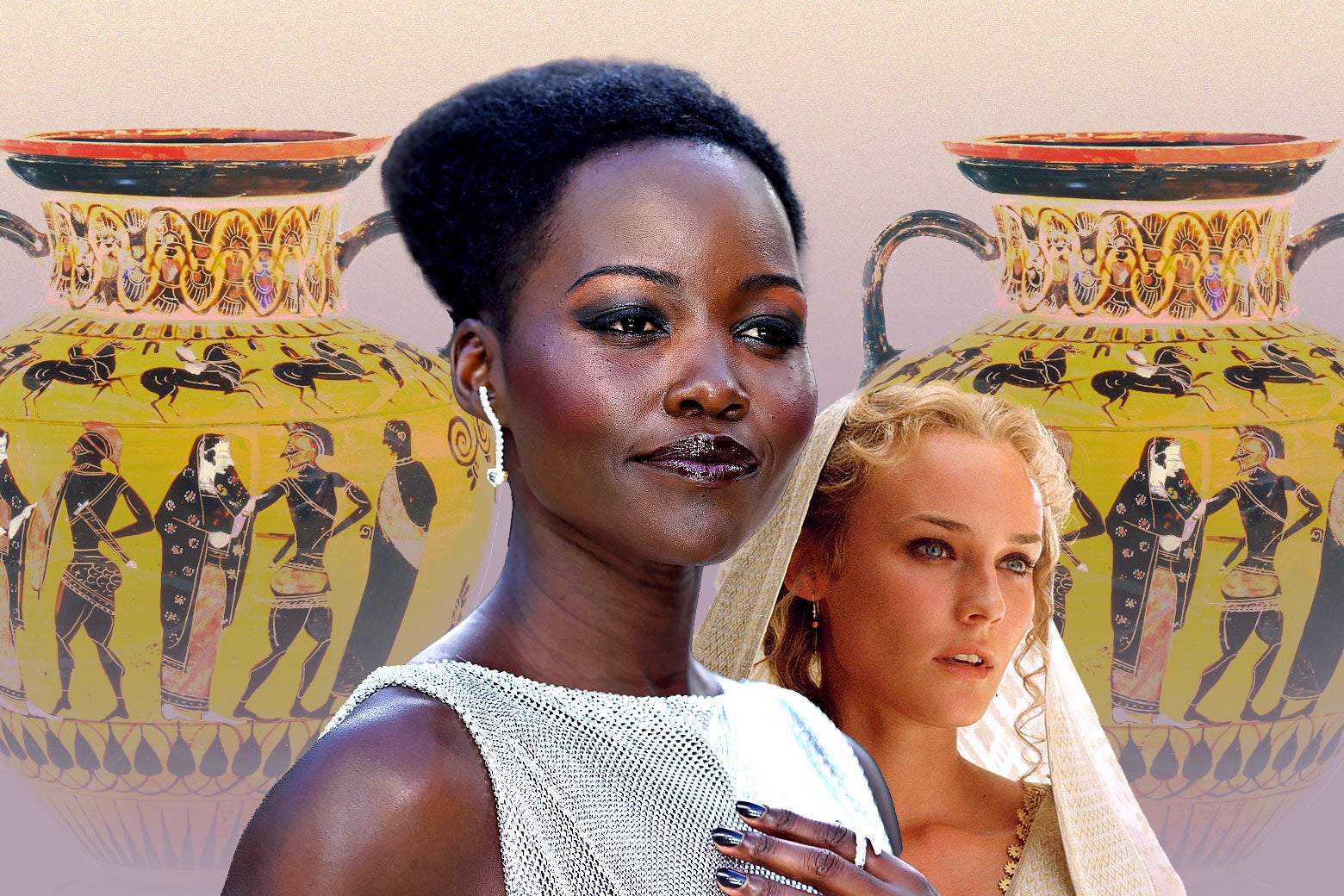
At this point, it’s par for the course for race-bending casting to be a way for a small, but vocal, contingent of the far right to prematurely discredit diverse films and television. This remains true with Nolan’s vision of The Odyssey, which includes the Kenyan Mexican actress Lupita Nyong’o as Helen of Troy (and her twin sister, Clytemnestra), a figure of beauty so immense, her face famously launched 1,000 ships and started the 10-year Trojan War. The popular contemporary imagining of Helen is as a blond white woman, like Diane Kruger’s portrayal in 2004’s Troy. Nyong’o is Black. Naturally, conservative figureheads kicked up a lot of dust about this casting; technocrat Elon Musk and conservative political commentator Matt Walsh decried the decision on X, while the cast of The View and Nolan himself rallied behind Nyong’o.
But is this choice even a race-bent one? After all, Helen, a mythological figure who is the daughter of Zeus, never actually existed. All we have left to point to, then, is the way she was ideated by the Greeks—evidence of which might paint a different picture than what we’ve been seeing in screen adaptations of Homer over the decades. To hash this out (and hopefully quell this endlessly frustrating iteration of the same debate we’ve been having for years now), Slate spoke to Denise McCoskey, a classics professor and affiliate in Black World Studies at Miami University and author of the book Race: Antiquity and Its Legacy. This conversation has been edited and condensed for clarity.
Slate: Upon the news that Lupita Nyong’o was cast as Helen of Troy in Christopher Nolan’s adaptation of the Odyssey, the culture war reared its head again. Because the film reportedly received 6.5 million euros in subsidies from Greece, some Greeks voiced dissatisfaction online about their own country’s money being used to, as they determine, inappropriately adapt their cultural classic by casting largely non-Greek actors. Elon Musk, meanwhile, said on X that the choice was proof that “Chris Nolan has lost his integrity,” alleging that Nolan had “desecrated the Odyssey so that he would be eligible for an Academy Award” [an untrue reference to the academy’s recently introduced representation and inclusion guidelines]. Musk’s comments were in relation to a tweet that asserts Helen of Troy is described as “fair-skinned” and “blond.” Is this true?
Denise McCoskey: In ancient literature it’s pretty rare to get a physical description of someone, in any length, whatsoever. The idea that Helen is more beautiful than anyone else, I think, is really a later idea. It’s not as if I would say she’s not beautiful based on what the Greeks say, but they don’t have this investment in some kind of miraculous beauty. I think they’re much more interested in the situation that she’s in and the way that she epitomizes the plight of women in some of these conflicts.
She might have an adjective applied to her, something like “golden Helen” or “sparkling Helen” or “beautiful Helen,” but how you translate those is a real question. What people are usually relying on for “blond” is a very specific adjective, which is xanthus in Greek, but it’s really hard to know. It’s very unlikely that the Greeks would do what we do, which is use a hair color as the epitome of a larger set of physical characteristics. Why should we assume that golden is a hair color rather than an aura? Why wouldn’t golden be something that’s describing a quality of character rather than a physical description?
I think that the notion of the Greeks as blond really begins in the early 20th century, around the 1920s and 1930s. So this is really the hangover from that, because, before that time, there was not at all an investment in a kind of physical type of Greekness. If you were looking for physical representations, the best source would be Greek vases, particularly black-figure and red-figure vases. If you looked at Helen on Greek vases, she would have dark hair, because that’s the convention of Greek women on vases. She would have white skin color, but that’s also because the convention of women on Greek vases was to have white skin, while the vases show Greek men with dark skin. Most people interpret that to be a kind of class distinction because Greek women would not go outside as much, and so the ideal was to have fair skin to show that you were of the leisure class, but that doesn’t mean that there’s an ethnographic idea of white women. And it’s also, in some senses, the mode of production, because you can’t show a wide range of skin colors on black-figure vases.
It’s interesting that Helen’s beauty and appearance were only second to what she represented, as a woman, in the context of the story.
The Greeks themselves were very invested in exploring these characters, and that’s where I think the far right just flattens out the meaning of all of these characters. Helen really was a figure that the Greeks used in order to ask questions about sexual politics and agency. I mean, one of the biggest questions in Greek text was not “Was Helen beautiful?” or “Was she blond?” It’s: “Did she go willingly?” They continue to explore that question. And some ancient authors are much more sympathetic to her than other authors are. Even Homer, I think, is pretty sympathetic to what’s happening around her, even though some of the Trojan women are not very sympathetic to her.
I’m more interested in seeing how she’s portrayed than worrying about the casting itself, even though I think it’s really interesting casting. But I think when they reduce Helen to just her appearance, or any of these characters to just an appearance, it’s just not how the Greeks would’ve been worried.
If you want to talk about historical accuracy, the Ancient Greeks would be far more upset that these things are not being done in Greek than about anything involving the appearance of these characters. To have Helen speak English is a far bigger transgression than to have her appear as a skin color that you don’t like. I think that’s something that is getting distorted for obvious reasons. And I don’t have a problem with that, if you want English-speaking audiences to engage with Helen—I teach English translations—but then you have to say that there’s a lot of ways we can translate Helen that has to do with our audience and what we want to think about today.
There are actually two debates being hashed out. The first involves the Elon Musks of the world who are framing an objective racial argument that they believe is based on a misappropriation of the actual source text. And then you have the second thing: an argument about beauty, which is much more subjective. For example, conservative political commentator Matt Walsh’s issue is that he doesn’t actually think Nyong’o could fit the description of the most beautiful woman in the world, which is certainly … an opinion.
We previously talked about whether or not Cleopatra was Black, in light of similar discourse surrounding the Netflix show Queen Cleopatra. In her case, you mentioned that the Romans crafted a narrative that you said “became so compelling” that it was reproduced over and over again, but that narrative was about “looking at” and “consuming” her, not understanding her. Is a similar thing happening here?
When I teach something like a Greek tragedy, the way that I think about it with my students is not that it says anything. I’m interested in asking: What does a Greek tragedy deliberate? And I think that that’s a better way to think of Greek myth, and it’s a better way to think of these characters. So what does Helen deliberate? What are the questions that circulate around her? What’s getting lost is asking: Who is Helen as a mythical character? Actually, what’s missing for me is the complexity of many of these characters. One of the things that’s really clear is that the far right has taken on Odysseus as a kind of exemplar of white Western manhood. And I think they read this story as the origin of what it means to be a man, the fact that he goes and fights for his family and his home and all of that.
But the Ancient Greeks are actually really skeptical about Odysseus. In later versions, by the time you get into Greek tragedy, he is often the bad guy. And what they don’t like about him, and what you see in The Odyssey, is he’s the weaver of tales, or, as Emily Wilson translated, a “complicated” figure. He’s someone who is very crafty with language, and, in later tragedy, the Greeks became really nervous about that and they portrayed him as someone who was really good at talking but very amoral. So, he could convince you of the argument through rhetoric, but not through morals. There are roots of that in The Odyssey, and if you think of him as this unproblematic character who’s doing all of the things that white Western manhood should be doing, you’re missing a lot of the epic. And I think, in some ways, the epic is trying to think about what happens when we go from war to a situation that doesn’t have war, what happens when we lose everything, as he does. But it’s a complete flattening out to see him as this uncomplicated hero. That will actually be interesting, to see how much Christopher Nolan or even Matt Damon is willing to paint Odysseus as morally ambiguous.
It’s so interesting that you say that, because there is a New York Times opinion piece by Daniel Mendelsohn that actually says very similar things about Helen. He argues that Helen “was a figure associated above all with profound debates about the nature of reality and the power of words, the seductiveness of falsehood and the fragility of truth,” and, because of this, her casting sparking controversy actually “connects us to the Greeks’ Helen in a far more authentic way than the choice of this or that actress could.” Do you agree with that assessment that a core part of her is that she’s a really astute communicator who was painted as controversial?
I agree with what Daniel Mendelsohn says, but the thing that I would add is gender. She is really emblematic not only of asking what is the role of gender, what is the role of marriage, what is the role of adultery, but, really, I think a key part of her story is war. And the Greeks are thinking of war and asking: What is the way that women feature in war? And so—maybe I’m a little bit more favorable toward Helen—I look at Helen as a character trying to survive. I agree that she can be deceptive in language, and she’s not always the most sympathetic person, but she’s trying to manage a system of power that is really set against her. And so I think we can learn a lot from that whether or not we like her.
But, in some ways, you could say the same thing about Odysseus. Odysseus is a survivor, but that doesn’t mean that he’s necessarily sympathetic. It’s the same way when the far right takes on Achilles. You have to really flatten out Achilles to think that he’s a war machine. If there’s one thing that you would say about Achilles, it’s that he’s undergoing the severe trauma associated with war.
I think what we’re missing are the questions that these characters bring to the fore. And I think, like Daniel Mendelsohn, that’s what makes them so powerful time and time again. They’re not instructing us on what is Western manhood, or what is white manhood, if you want to be Elon Musk. And I don’t think Helen is instructing us about what’s beautiful, the way that some people want to do that. I think that she’s being used to ask a lot of questions about survival and warfare and sexuality and desirability.
Especially since her beauty isn’t something that she owns, right? Her beauty is a gift to Paris, not to her. Still, something that happens every time we debate this is that one of the strains of defense centers on the fictitious nature of these tales. Similar to the backlash of a Black Ariel from The Little Mermaid, many people countered with, Well, mermaids don’t exist, so why are we standing here talking about whether or not this mermaid should be Black or not? There is a similar thing going on here. Helen doesn’t exist. There is a Cyclops in this story. Do you think that it’s a useless question to debate her race or do you actually think that there’s some merit in the discourse?
These myths are powerful because they’re both taking advantage of a sort of affiliation with the past but they’re also always reinterpreted in the present. So when, three centuries later, Greek tragedy puts Helen on stage, they can reinterpret her within a 5th-century context. I just don’t think the Greeks have a Helen that you have to represent. I think they are so used to these characters being transformed and used to think about other things that it’s not a problem to also do that. What’s more interesting is trying to find from the film an answer to the question: “Why in our moment?” Why does it matter that Helen is Black in our moment? And what is the film going to tell us about that? I think a 5th-century audience could have asked, “Why is Helen so mean in this tragedy? Why has she been changed to be that?”
And so I don’t think there is this or that Helen. Helen was constantly being rethought. That process of rethinking her in and of itself is not opposed to what the Greeks did with her at all.
As modern audiences, “What are we going to get out of that decision?” is a really relevant question to ask, but I wouldn’t ask it based on her appearance alone. I would ask it within the course of the film: What does this treatment of Helen do for a 21st-century audience? I don’t think that the casting is inconsequential at all, but I think it’s only a small piece of what we are going to see of Helen and make sense of from the movie as a whole.
You’ve done some research since we last spoke about the far right’s investment in classics. Do you see any connections between what you’ve gathered and what’s happening with this Helen of Troy discourse?
Coming out of the 19th and into the early 20th century, as racial theories are starting to develop, it’s not just that certain Western groups want to see a cultural connection to the Greeks, they also start to invent this racial connection. And so they start to impose on the Greeks this idea that they are Nordic, in particular. But this would mean that the Greeks should somehow have an origin in Northern Europe, which just makes no sense historically, but it has been a hugely intractable version of antiquity. So a lot of the people, like the Elon Musks of the world, they’re really going back to a lot of this theory. And, in fact, at times, they’re actually using classical scholarship on this theory, so they’re reprinting essays from the 1920s and 1930s to show that they’ve read classical scholarship, because classical scholars were invested in this idea of the Greeks as Nordic as well. They’re trying to cast these stories as quintessentially white Western European stories, and I think there’s a lot of reasons that that just doesn’t hold up.
On The View, Sunny Hostin referred to an idea that Greece had come from Africa and mentioned that that’s what Christopher Nolan was trying to acknowledge with this casting. I think that’s a pretty blunt reading of something like Black Athena [a heavily criticized book that proposes this theory], and I’m not sure I would push that, either. Writers like Toni Morrison got very invested in this idea that Greece had come from Africa, so I think it’s a really important train of thought in African American culture, but I don’t think that’s the best argument.
I think it’s just safer to leave race out of it. I don’t think you correct a white Greece by saying it was a Black Greece. I think that you try to contextualize the fact that race was not really part of their origin story at all. I mean, I just don’t think that they’re thinking racially. They have a tremendous amount of respect for ancient Egypt and they’re sort of competitive with ancient Egypt. And I think you can say that there’s a huge amount of cultural contact without really racializing it, because I just think that’s a modern idea. I don’t want to completely dislodge that idea, I think it’s an important corrective, but I don’t know that it’s the right narrative for this moment in time with what Christopher Nolan is doing in the film.
If anyone is interested in how Helen of Troy has been depicted, which would you suggest they turn to, if there are any translations or pieces of media or artifacts that point to the original preserved representations of her?
There’s a whole book on Helen, Helen of Troy: Beauty, Myth, Devastation, by a classical scholar named Ruby Blondell, that looks at her across the ages, if you wanted to get a kind of introduction. As a genre, if people are interested in the visualization of Helen, I think it would be useful to look at Greek vases. I think, in terms of a literary text that looks at Helen, I would suggest something in Greek tragedy. Euripedes’ The Trojan Women is a play about what happens after Troy, and it shows all of these different women, and in that play Helen really has to argue for her survival among other women, and she has to kind of answer for Troy. I mean, she actually has quite a lot to say in the Iliad, but if you wanted to hear more, I would suggest The Trojan Women.
But the other thing I would say is just how relentless this story about Greek whiteness is going to be. I mean, that’s also the thing that, with Elon Musk speaking out right away and all that, it’s just like, Here we go again. And I don’t want to underestimate that because that’s a powerful person and that’s a powerful internet chamber promoting those ideas, and so I can’t even pretend to know how some of these people are going to be harassed by fans and everything when the movie is finally out. But it says a lot for what they want to do at this moment that [the cast and filmmakers behind The Odyssey] are not going to cave in.